Categories
PCT Reflections

Pleasure-Way: an interview with 2021’s best Trail Angel

Have you have ever thought about becoming a dedicated trail angel or hoped that someone would take on this role during your thru-hike? If so, this blog is for you. I caught up to Pleasure-Way for an exclusive interview about her secrets to being the best trail angel on the PCT in 2021.

Thank you for taking the time to join me today now that you have moved out of your van. My readers have been asking – what is the real story behind your trail name, Pleasure-Way?

Pleasure-Way: As is the tradition, my trail name was offered to me by a hiker, Twister, and I decided to go with it. I get some smiles and comments when people first hear it but bringing pleasure to thru-hikers in the form of food, and moral support is what trail magic is all about. It is also the van’s name, so hikers make the connection right away.

Ribs and Scott preparing for entering the Sierra with Pleasure-Way.

Your name certainly worked; I have met hikers that knew about Pleasure-Way and had no idea who Ribs was. How long were you living on the road, and what were some of the high and low points you faced?

Pleasure-Way: Staying in the van for the better part of five months was certainly a new experience. I was very comfortable driving and operating the vehicle and covered over 13K miles since leaving home. The van gave me a feeling of self-sufficiency, and I could control my physical space during the spring when the vaccine rollout was ramping up. I enjoyed the simplicity of living, exploring, and seeing new roads, parks, and towns from Mexico to Canada. I met a lot of interesting people, both thru-hikers and fellow travelers. I won’t miss laundromats or driving the steep and narrow roads without guardrails to get to some of the remote trailheads. I also won’t miss buying deli chicken for trail magic – a real hit with the hikers, but I hope I never see it again.

Pleasure-Way, at Scissors Crossing, was already meeting an interesting mix of past hikers that return every year to provide trail magic.
On the road again, Pleasure-Way got to know California’s HWY 395 quite well.
Pleasure-Way had to navigate blazing heat, snow, and wildfires.

How would you describe your role in terms of supporting Ribs?

Pleasure-Way: My overall role was to provide options for meeting to make Rib’s life a little easier.  There was a chance for a shower, home-cooked meal, and equipment exchange (no longer need that ice ax? trade out the old shoes?) as well as a chance to fill out the wish list (new items from REI, specific food requests). We would exchange food supplies for garbage, clean clothes for dirty, and reassess the plan for the next segment.

Coming off the trail at Stevens Pass – the trail magic begins.
All the resupply gear was in labeled boxes making repacking and gear changes easy

What was the most challenging part of supporting Ribs?

Pleasure-Way: The biggest challenge was that the plan changed constantly. We learned this early on when Ribs hiked faster than expected – so the initial plan, which had campground reservations up until Kennedy Meadows, was flawed from the get-go. I had little problem making new reservations in the spring, but it became harder to find open spots as summer began.  I discovered fewer available campgrounds with hookups north of Kennedy Meadows, so I had to rely more on private RV parks. Some RV parks were very nice, like the Mountain Gate RV Park south of Shasta Lake. Other locations along the way were less inviting but met the needs for safety, power, water, and sewer. So, my biggest challenge was figuring out when and where to locate the Sprinter van when it was not a meetup day. I also learned that Ribs became very focused on the next trail segment and had trouble planning beyond that. I started making predictions and then adjusted as needed.

Life in the van became the new normal.
Dusk at Lake Cahuilla Regional Park near Palm Desert.

My takeaway from your last answer is that you would create detailed plans and be okay if Ribs hiked faster or made some other changes and then you would do it all again – sounds frustrating. I guess that’s why they call you a trail angel. What was the most fun aspect of being a part of this hiking team? Beyond the logistical support, what did you find was needed to support Ribs from a psychological or emotional perspective?

Pleasure-Way: I truly enjoyed hearing the stories from the trail and getting to know other thru-hikers in real-time. At first, Ribs was reluctant to connect with other hikers and was self-conscious about my support. I jumped in and started engaging other hikers, and we both enjoyed being a part of their hiking teams. His physical stamina improved, so he looked fresh coming off the trail, but I noticed early on that he was not tracking day-to-day life as is usual. For example, I told him about a young swimmer from Alaska, Lydia Jacoby, winning a swimming gold medal. It caught my attention since my parents met in Alaska. He asked if it was at the world championships. He did not even know the summer Olympics were going on, one of his favorite sporting events. I tried to be patient and actively listened when he came off the trail, offering positive reinforcement that this was doable for him. I reviewed my latest plan with him for feedback rather than creating it together.

It was common for Pleasure-Way to transport hikers to and from the trail head.
Pleasure-Way, Ribs and family greeting a young family with some young girls who are very interested in becoming PCT hikers.

It sounds like you also had to deal with a lot of uncertainty about Rib’s condition when he came off the trail. What did you both do to get him recharged and back on the trail?

Pleasure-Way: We became experts at overnight meetups at trail/road intersections to resupply and get him back on the trail in the morning. We did this 30 times, which was a key reason we pulled so much time out of the original plan. Ribs provided pretty accurate estimates when he would arrive, and he pushed the mileage to arrive in the afternoon. In some cases, I would hike down the trail to meet him, which was fun. I had some high-calorie foods for immediate consumption to start the recovery. He would typically shower, and we would talk about the upcoming trail segment. He would then unload and re-load his pack using a checklist with different gear based on the length and weather conditions. We had a duplicate set of clothing, making it an easy swap. Originally, Ribs only wrote blog posts when he took a day off (zero-day). He started reducing zero-days as the hike progressed, so he would dictate the blog on the trail and then edit it and post that night. Dinners became increasingly simpler as the hike progressed to suit his changing dietary needs. He was typically out on the trail by 6 AM the following day.

Ribs getting his first blast of calories after getting to the van.
Finishing a blog post after dinner before heading out the next morning.
Pleasure-Way sent Ribs out with a killer breakfast including protein blueberry/banana pancakes, three eggs, fruit and more.

Wow, your description reminds me of a pit-stop in the Indianapolis 500, except you are changing tires on a thru-hiker. What tools did you develop or use to be so successful?

Pleasure-Way: One of the most important tools used during the five months was a daily itinerary of the hiking plan over the entire PCT. Ribs created the first version to capture his initial guess. I used this tool to plan the hiking segments, resupplies, overnight meetups, and zero-days. It was created to be easily modified along the way and, in the end, serves as a detailed diary of each’s day’s progress. Ribs communicated his location and how he was doing every night from the trail using a Garmin satellite device which kept us connected and informed. I was also able to update him on any weather and fire concerns.

I took this initial plan and noted intersections of the trail with roads accessible by our Sprinter van.  The large state atlases helped find the roads, but the crucial pieces were the National Geographic PCT trail maps and the Guthook app. After finding an intersection, I would map it through google maps to evaluate the route and check for road closures.  I would complete the analysis with a final check back to the atlas to ensure that the road was drivable. In general, I tried to stay on paved roads since the quality of gravel/dirt roads is hard to predict (my vehicle wasn’t 4WD).

Pleasure-Way’s headquarters to do her logistics magic from Brite Lake.
Pleasure-Way’s view while staying at lake Almanor.

My takeaway is that you were the one keeping track of the overall logistics and figuring out when and where you could deliver trail magic. All Ribs had to do was walk 12 hours a day; frankly, it seems like he had the easy job. What did you do on the days when you were not together?

Pleasure-Way: I needed to develop a second plan besides the PCT to park and stay in the Sprinter van safely. I could go 3-4 days without electrical or water hookups, staying for free on BLM lands or campgrounds. We would often boondock at the trailhead or in nearby BLM land or NFS campground for overnight meetups.

The ideal situation for me on my alone days was to find a centrally located campground with hookups. One of my favorites was the Brite Lake Campground, a county park outside of Tehachapi, California. I had ten days there, very happy to have the electrical hookup to allow for air conditioning. Sometimes I picked up Ribs and brought him to stay the night in the campground, but other times I met Ribs and stayed at the trailhead, returning to the campground the following day.

I was surprised to find that getting a hotel wasn’t a relaxing break for the most part. It did not remove the need to care for the Sprinter van (where to park, how to keep its power, etc.) For example, I was given a Mother’s Day present to stay in a nice hotel at Mammoth Lakes. I found out just before dark that they recommended I not leave any food in the vehicle because bears will break into unattended vehicles, even RVs, to get the food. I hauled my food, as well as Rib’s food supplies, into the hotel room.

Pleasure-Way giving Ribs encouragement as he left Trout Lake in Washington.

Thank you for telling us your secrets – I have a much better understanding of what it took to be the best trail angel in 2021. No wonder Ribs says that you are the key to his successful PCT thru-hike. What are the top five things our readers should know before taking on your role as a dedicated thru-hiker trail angel?

Pleasure-Way:

  1. Be patient, expect constant change, both of the route and the needs of the thru-hiker.
  2. Find meaningful ways to connect with others.
  3. Let others know where you are.
  4. When possible, stay where you have internet/cell connectivity to keep from being isolated – have frequent phone calls with family and friends.
  5. Buy two Garmin satellite communicators, one for the hiker and one for the van, to stay in touch when either one is without cell coverage.
Categories
Hiking the PCT

The Elusive Glacier Peak

I just completed the amazing and challenging Glacier Peak Wilderness section of the PCT. In six days, I covered 127-miles from Stevens Pass to Rainy Pass with 38K feet of climbing. There is a lot to unpack from my past and current attempt to enjoy the elusive Glacier Peak.

The first attempt was back in college organized by my brother, Bill. The three-day trip was to enter from the west then climb up one of the ridges to enjoy a view of Glacier Peak in all its splendor. We entered via a lush forest trail on the first day before climbing the ridge. We were caught in a torrent so heavy that it flooded our tent. It was so bad that the mice decided to shelter in our tent and raid our food. I remember six people covered in mud trying to dig drainage ditches, fend off mice, and stay warm. Defeated but not dejected, we exited and found other ways to spend our 3-day weekend. I wrote that trip off to inexperience, bad gear, and bad luck.

The second attempt was on my shoulders, leading my family into a similar hike to view the magnificent Glacier Peak from a ridge to the west. The results were the same; we climbed, were destroyed by a rainstorm, and exited with never a glimpse of the mythical peak. This disaster was entirely on me as I chose to ignore the weather report and advice from the ranger at Darrington.

It is only reasonable that my third attempt to hike near Glacier Peak made me nervous. Upon leaving Stevens Pass and climbing the ridges from the south, I was amazed to take pictures of what I thought might just be a legend. However, after climbing Red’s Pass and dropping into a river valley, Glacier Peak disappeared once again, shrouded in smoke from a fire. That set the tone for six days of massive climbs up and down the river valleys surrounding Glacier Peak with glimpsing views through the smoke. Early on, I committed to returning to this magnificent area a fourth time to explore without the threat of fires.

I now have a much clearer picture of both the beauty and the difficulty of the North Cascades. The glacial peaks (Washington has 186 named glaciers versus Oregon 35 and California 20) remind me of the Sierra and the Alps. The 3,500-foot descents and climbs traverse thickly forested river valleys, dense underbrush, and open scree fields. I swam in two glacier-tinted lakes and felt every cell shout, hell yes. I saw plenty of bear scat and heard elk bugle at sunset. I have not backpacked in Alaska, but one thru-hiker made that comparison. The challenges mainly came from the relentless climbs, the bugs, and staying cool during another heatwave. Hikers don’t mention the mosquitos in these parts because they are hardly noticed amongst the swarming small biting flies and the Imperial-Trooper-sized deer flies. Within two days, I was at my wit’s end.

On the third morning, I sent Pleasure-Way a message on my Garmin saying I felt like stopping. She wrote back, “hang in there; you got this.” I met Endless and QB, two triple crown hikers from Boston, who provided some much-needed support. “We are being tested; you got this.” I can’t tell you how much the phrase “you got this” helps from family, friends, and fellow hikers. It may sound like a two-bit cheer, but it sure does the job. “You” is speaking to the many layers of self that have walked this journey with me. “got this” is an affirmation that I have developed the body, mind, and practices to finish this hike. It is hard to put into words how important your support is.

I have 61 miles and 16.3 K feet of climbing to reach the border. I will then turn around and hike 30 miles back to Hart’s Pass. See you on the other side.

I have visited many wilderness areas on this hike. This sign sent a shiver down my spine.
I had to pull out my map to confirm that this was the elusive Glacier Peak.
The climb up Red’s Pass gave me the first glimpse of the four additional passes ahead.
You can barely make out Glacier Peak in this photo. Depending on the ever-changing smoke and light, it would fade in and out over the next four days.
I faced a dangerous river crossing early on my third day when I felt like quitting. I wrote the following Haiku, and this river crossing brought me back to the present moment.
 
The log is the way
My feet lead me through chaos
There is nothing else
The layers and layers of underbrush were beautiful and sometimes claustrophobic.
Swimming in Mica Lake, pure joy and brought my core temperature down instantly.
The view from my campsite on day four; I didn’t even know these mountains were there when I hiked in through the smoke and fading light.
Navigating around blow-down trees is hard enough. In Washington, they can be the size of a house.
Cooler weather and even some showers came in on day six; what a relief.
Categories
Hiking the PCT

My Backyard

In 2008, my son Mitchell and I started PCT section hiking with a 45-mile hike through the Sisters Wilderness Area. Retracing those steps, I recalled many funny stories and truly appreciate how fortunate I am that this is my backyard. It is more accurate to say that this is our backyard. These public lands are preserved for generations to come. These lands were the ancestral homes of the native peoples who lived here sustainably over many centuries before colonization.

It is natural and appropriate to have pride in the place we live. That was on full display during the hike in 2008 when I would ask the thru-hikers what their favorite section was so far. I was waiting for the correct answer; “it’s here in the Sisters”. The only response we heard was the Sierra, which did pique my interest to hike there. Over the years, I have doubted whether the Sisters Wilderness was, in fact, as special as I believed it to be. I will let you be the judge as you look at my photos from the last two days. I re-discovered the uniqueness of this combination of volcanic peaks, deep forests, and open plains. I have not seen anything like it.

One of my favorite stories from 2008 was our packs, which we felt were lightweight because they were less than 40 pounds. We were amazed to see thru-hikers zip by with what we would consider day packs. I remember Dragon Ant; he had a tiny pack and was logging 40 miles a day. I can still see him almost skipping over the ground. We got lost in the snow for at least 3 hours, developed an amazing array of blisters from hiking in wet boots, and did not carry enough water to cross the lava flow section. Despite all our troubles, Mitchell went on to section hike 800 miles in 2015, and I crossed the 2000-mile mark today.

The lesson that I share with hikers that I meet along the way is to be patient with yourself. Whether this is your first backpacking trip or you’ve been doing it for decades, you always make mistakes. You must learn and be adaptable whether your body is not performing as you’d hoped, or your gear is not working, or external factors change unexpectedly. The critical thing is that we develop our ability to accept, adapt, and learn from all that we experience. And that’s why every day, every step is a new adventure.

This week I’ve met folks from Oklahoma, Texas, Idaho, and Pennsylvania who have come to hike the Sisters Loop Trail. I welcomed them all to play in our backyard.

Mt Thielsen is the first peak to welcome north-bound PCT hikers. I climbed Thielsen last year and could see into Crater Lake from the summit.
This group provided some much needed trail magic at Summit Lake near Diamond Peak; some Oregon hospitality.
Diamond Peak from the north is normally not visible from below. This basin has a lot to explore and climb.
Walking towards my beloved South Sister, it does feel like my backyard.
North and Middle Sisters from the north show the glaciers and ruggedness of this area.
I was wrong in an earlier post, this is the way to Mordor.
Really, it can’t possibly be almost over. The celebration for completing mileage is getting a bit more subdued.
Categories
Hiking the PCT

1325 Father’s Day Gifts

It is hard to believe that I have now hiked past the PCT halfway point of 1325 miles. I do not think it was a coincidence it happened on Father’s Day. I spent my day trying to remember as many family hiking trips as possible. We had trouble keeping track, so we made a list that now tops 50 hikes. As my thoughts bounced between memories, I realized that I had missed the essential point. Our enjoyment of the outdoors was only made possible because of how genuinely gung-ho everyone was and still is to take these adventures. The family must embrace family vacations, and I had never appreciated how much it shaped the journey I am now on.

The majority of our trips were base camping, where you backpack into a scenic location and hang out together. Let’s be honest; these are a pain to plan and pull off. You’ve got to organize everything, including what food kids will eat, cram everyone and the gear into a car for a long drive. The packs are notoriously heavy, start times often in the heat of the day. The mosquitoes show up just as the energy dims. Finally, life on the trail is not exactly comfortable – sleeping on the ground and the lack of bathrooms is a whole other chapter. There is a lot to douse one’s enthusiasm. And yet, since 1997, we have been out there again and again. So, I dedicate the first half of my hike to those who jumped in with both feet every time.

Glissade training on Mt. Rainier in 1996
Our first family backpacking trip into Green Lakes in 1997 (I was 6’2″ before putting on this 70 lb pack)
Snow in the Wallowas in 1999 (why are these people smiling?)

As a recap, I have covered 1366 miles in 63 hiking days for about 21.5 miles per day. Numbers don’t tell the story because every day, mile, and bend in the trail unfolds independently. Poet David Whyte wrote the poem Start Close In, which is the perfect prompt for a long and uncertain journey. The opening stanza comes to mind when I look back at the first mile marker on the PCT.

Start Close In (First Stanza)
     Start close in,
     don’t take the second step
     or the third,
     start with the first thing
     close in,
     the step
     you don’t want to take
             David Whyte
Fortunately, these were not posted every mile.
I had to work through many issues to reach 100 miles
The 1000 mile mark was towards the end of the Sierra
The midpoint marker is fitting, an unremarkable post in a densely forested section of Mt. Lassen National Park
Categories
Hiking the PCT

Scott: Wildlife in the South Sierra

A few weeks ago, I was lucky enough to get on the trail with Ribs for a beautiful stretch of California. Starting at Kennedy Meadows and finishing up at Kearsarge Pass (read all about it if you missed it). The trip was a great endnote for my year-plus of COVID-19: It kicked off with a final vaccine dose, my first air travel in over a year, and hugs from family members. But it also was an opportunity to put to use while backpacking a past-time I picked up during lockdown: Bird Watching.

Bird Watching and thru-hiking seem like an uneasy pair; often, you get the best results birding by standing still and walking very, very slowly, anathema to a thru-hiker who’d rather be on their feet or sleeping. However, just by being up for almost the whole day – you’re given an opportunity to observe birds and critters as they go about their days and see how their rhythms match or miss that of a hiker.

Along our 110 mile hike, we spotted several birds (and other critters) that I often see around Portland – Juncos, Chickadees, Crows, Chipmunks – but I wanted to share a few of my favorites that I notice along the trail:

Cliff Swallow

Cliff Swallow | Audubon Field Guide
Photo Credit: Audubon Society

Even before we hit the trail, we were bumping into Cliff Swallows as we boondocked at Kennedy Meadows, and they also greeted us at our first camping site along the S Fork of the Kern River. These little birds will make nests alongside the edge of cliffs (or bridges in these cases) made of mud and swarm into huge flocks to catch bugs. As the sunset on the first night, Ribs and I watched them fill up the sky. These little guys tended to come out when we were making or breaking camp.

Clark’s Nutcracker

Clark's Nutcracker Identification, All About Birds, Cornell Lab of  Ornithology
Photo Credit: All About Birds

After we’d hit the trail and got moving through a sparse forest of ancient and sometimes fire-scarred sequoias – we’d often spot these flitting in between the trees, usually at the edge of our vision. They didn’t tend to call out, but you’d see them watching us along the trail. A relative of crows and jays – they tended to be a bit shy – staying active throughout the day on our hike, only disappearing around late afternoon.

Townsend’s Solitaire

Townsend's Solitaire Adult
Photo Credit: All About Birds

As we ascended higher into the Sierra – camping at 7000 ft, then 9000, then never coming below 10,000 – I noticed a very complex bird call that would start in the mid-morning and then reemerge in the later evening. It took me a few days to finally spot the culprit – this small gray bird that would hang out on shrubs. It’s apparently a huge fan of juniper and likes to hang out in the higher elevations during the breeding months.

Gray-crowned Rosy Finch

Gray-crowned Rosy-Finch Identification, All About Birds, Cornell Lab of  Ornithology
Photo Credit: All About Birds

We climbed Mt Whitney at sunrise on the fifth day and hunkered down to eat our breakfast from the wind. One of these little fellas took our presence as an open invitation to crash our party – coming very close to our sleeping bags and oatmeal. Despite our protestations – it persisted by dodging and weaving around us to gain access to our treats. Another high-altitude forager, these birds can often be found on snowfields foraging for seeds. Stealing food from altitude-addled climbers does seem much easier by comparison.

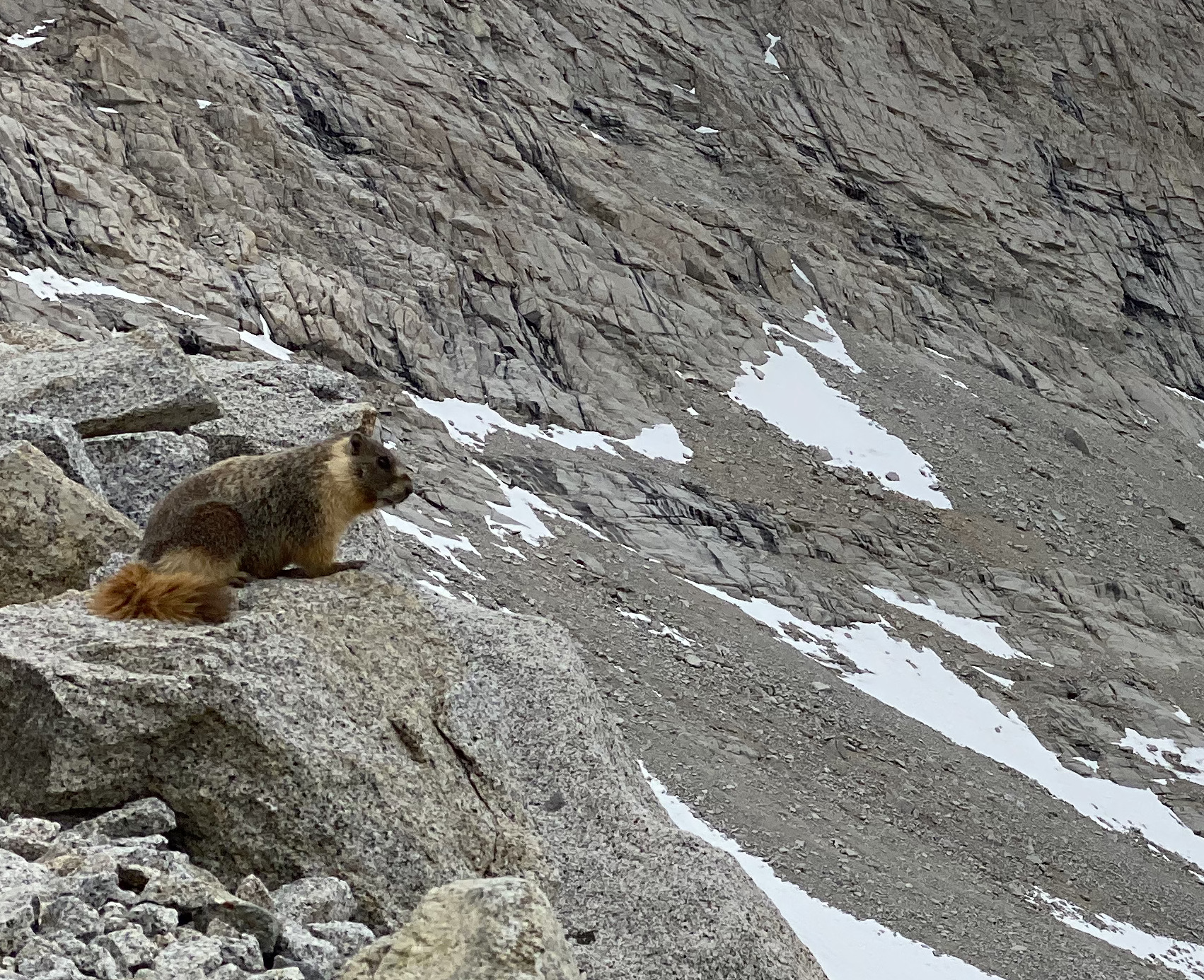
Yellow-bellied Marmot

A marmot surveys Forester Pass, Photo Credit: Me

Of course, we encountered many more critters than just birds – from our first day on the trail, we started to see bushy tails hard at work just off or on the trails. They’re probably busy preparing for mating season – marmots are polygynous with the males attracting several females – and so had a lot to get ready. One surprise was the silent treatment we received from these Marmots – on a previous hike late in the season near Washington’s Goat Rocks (1500 miles in Rib’s future), they would stare us down and emit a high pitch bark to warn their burrow-mates.

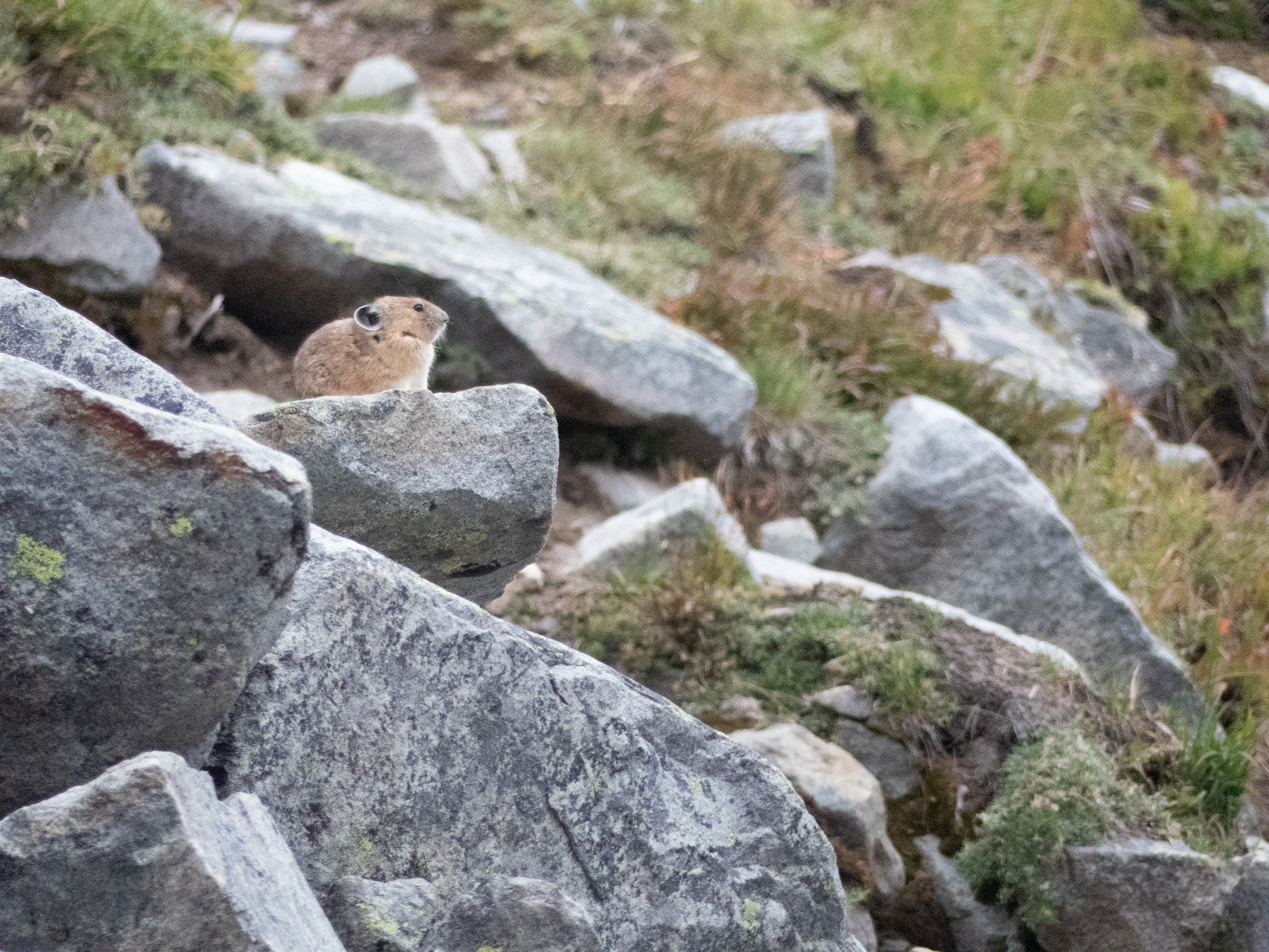
Pika

Pika on Mt Rainer, Photo Credit: Me

Speaking of suddenly quiet, we were also surprised by the stony silence we received from Forester Pass’s Pika population. These high-elevation rodents (which we also encountered in the Goat Rocks) are always on the lookout and will squeak to warn the colony when outsiders trespass on the rocky scree where they make their burrows. We only encountered a singular Pika who maybe could tell from our micro-spikes and hurried pace that we wouldn’t be staying long at 13,000 ft as the snow started to fall.

Coyotes

Be cautious of Lake Tahoe's wily coyotes – Toree's Stories | SierraSun.com
Photo Credit: Sierra Sun

Coyotes were with us for almost our whole journey: from the road up to Kennedy Meadows to our first morning on the trail – their omnipresent prints and scat attests that the Sierra are their mountains. I had been feeling left out after both my parents had spotted their own until I finally bumped into one at Guitar Lake on the way down from Mt Whitney. The large coyote ran along the trail, towards but then away from me, pausing when he was far enough along to give me a once-over before a full-body shake. “Eh, not worth it,” it seemed to taunt with that shake before climbing up the valley towards an easier lunch.

The South Sierra is a landscape of contrast – granite peaks tower over some of the driest and lowest parts of North America. That elevation and rain shadow catches moisture as it moves across the continent, cultivating a lush landscape where life – sequoia, juniper, and mountain meadows – can thrive. And it was a great joy to get to hike through it all and take it in.

Categories
PCT Reflections

Wishing you were here

I have turned the corner and started to head north again. I am taking a zero and will restart the trail on mile 511. I have achieved a significant milestone – crossing the 500-mile mark, but it is bittersweet. I had to skip miles 486 – 511 due to a trail closure because of the Lake Fire. This is the second section of the trail closed by recent forest fires.

Ideas for what to write typically come and go. This post has been with me for three weeks emotionally, even though the pieces don’t seem evident on an intellectual level. Sharing what I am experiencing on the trail can feel like trying to explain a dream to someone – so please bear with me.

Apache Peak fire after 12 years

As soon as I started climbing mountains in Southern California, I experienced the scale and devastation of their wildfires. Many areas of the trail have been closed due to unstable soil and the danger of falling debris. The above photo from Apache Peak shows the damage 12 years later. I live in the northwest; I am used to hiking through some burned sections of the forest. But here, it is the norm – day after day.

Ten miles north of Apache Peak

I noticed my pattern of ignoring the burned sections and pushing through to the lush forest. The dense forests along the PCT in Southern California are few and far between. I understand that forest fires play a role in natural ecosystems. Still, we have crossed into a new regime of fires that burn hotter and more frequently fueled by higher temperatures, frequent interaction with humans, and misguided fire suppression methods.

Holding the wisdom of generations

I’ve always had a thing for trees. I befriend trees in our local forests and look forward to visiting them. I feel comforted by them, and they give me a sense of wisdom that spans the generations. On the trail, I have started touching them to connect on a different level and sometimes even chew on a small piece of bark. Many date back 400 years or more, and although they are independent, they survive together. Thru-hiking into a grove immediately calls me to attention.

Los Angeles Forest (taken by “Twister”)

To see even one, let alone scores of these wise giants, fall together gives me a feeling of extreme loss. They know how to withstand fires, and by the time they reach maturity, they have seen many fires come and go, and their bark bears these scars. But they were not built to withstand the infernos of these times.

Bill and I playing in the White Clouds

The unexpected and tragic loss in the natural environment has frequently brought me back to those I have lost in life. My brother loved sharing wilderness adventures, was as kind, strong, and determined as they come, and became a kid when he was outdoors. We became two kids, the same ones who shared a bedroom for most of our childhood and talked about everything under the sun. He was swept away by cancer too young. He would have been so engaged in my hike, whether on the trail or giving me his full support.

Walking the trail provides a constant reminder of how fragile and precious life is – including the lives of all that share the earth with us.

Categories
PCT Preparation

Why do it

My question, along with most others, is why hike the Pacific Crest Trail? It is a completely logical question. And honestly, I don’t know why – I will need to get back to you on that. In my defense, I have had accomplices for a decade when it comes to getting swept away by magnificent PCT sections in the Sierra Nevada Mountains of California and the Cascade Mountains of Oregon and Washington. On another occasion, I was standing at the start of the PCT being mesmerized by the possibility.

It started with Todd in 2011 on a trip into Marie Lake and then summiting the Seven Gables. My previous hikes were in Idaho and the Pacific Northwest. The Sierra is like a different planet and we had just scratched the surface.

Alesia and Scott got into the act with a six day trip into the Ansel Adams wilderness in 2014. The trap was closing and I was looking for any excuse to get back there.

Mitchell hiked 800 miles of the PCT in 2015 before starting law school. I took him down to the starting point in Campo California. I asked if I could hike the first few miles with him and he had to order me to turn around after three miles. The pull of the trail and the adventure really surprised me.

Jenessa’s friend offered her two permits to hike half of the John Muir Trail 2017. I begged to get the other permit and against her better judgment, she agreed. We spent nine days on the trail to Yosemite. That thru-hike made me realize how much I love waking up every day and just walking. And so here I am.

Categories
PCT Preparation

My WOX

Before looking ahead, the question is – what stands behind me; my Wilderness Origination eXperience, or WOX. Blindly, I assumed that everyone who was interested would learn about and take advantage of wilderness experiences. The data shows this could not be further from the truth. For many, these wild places do not feel welcome or safe. Fortunately, the outdoors is now avidly enjoyed by both genders, but people of color or those never exposed through family or friends do not have a WOX, and the door remains closed.

I now realize my WOX was a rare gift given to me by my father. My father’s WOX happened when he was in his 40’s as he supported my oldest brother’s pursuit of a Wilderness Survival merit badge. My life would not be the same if I did not spend countless days scrambling up the highest ridge or finding myself in a never-ending universe. But mostly, the gift is memories of being with those that I love.

My father’s hiking hat is at the center of some of our most bizarre stories. His hat is now resting in a cairn high above it all. His spirit and all those I shared the trail with are coming with me on this adventure. Let’s do this.