A few weeks ago, I was lucky enough to get on the trail with Ribs for a beautiful stretch of California. Starting at Kennedy Meadows and finishing up at Kearsarge Pass (read all about it if you missed it). The trip was a great endnote for my year-plus of COVID-19: It kicked off with a final vaccine dose, my first air travel in over a year, and hugs from family members. But it also was an opportunity to put to use while backpacking a past-time I picked up during lockdown: Bird Watching.
Bird Watching and thru-hiking seem like an uneasy pair; often, you get the best results birding by standing still and walking very, very slowly, anathema to a thru-hiker who’d rather be on their feet or sleeping. However, just by being up for almost the whole day – you’re given an opportunity to observe birds and critters as they go about their days and see how their rhythms match or miss that of a hiker.
Along our 110 mile hike, we spotted several birds (and other critters) that I often see around Portland – Juncos, Chickadees, Crows, Chipmunks – but I wanted to share a few of my favorites that I notice along the trail:
Cliff Swallow

Even before we hit the trail, we were bumping into Cliff Swallows as we boondocked at Kennedy Meadows, and they also greeted us at our first camping site along the S Fork of the Kern River. These little birds will make nests alongside the edge of cliffs (or bridges in these cases) made of mud and swarm into huge flocks to catch bugs. As the sunset on the first night, Ribs and I watched them fill up the sky. These little guys tended to come out when we were making or breaking camp.
Clark’s Nutcracker

After we’d hit the trail and got moving through a sparse forest of ancient and sometimes fire-scarred sequoias – we’d often spot these flitting in between the trees, usually at the edge of our vision. They didn’t tend to call out, but you’d see them watching us along the trail. A relative of crows and jays – they tended to be a bit shy – staying active throughout the day on our hike, only disappearing around late afternoon.
Townsend’s Solitaire

As we ascended higher into the Sierra – camping at 7000 ft, then 9000, then never coming below 10,000 – I noticed a very complex bird call that would start in the mid-morning and then reemerge in the later evening. It took me a few days to finally spot the culprit – this small gray bird that would hang out on shrubs. It’s apparently a huge fan of juniper and likes to hang out in the higher elevations during the breeding months.
Gray-crowned Rosy Finch

We climbed Mt Whitney at sunrise on the fifth day and hunkered down to eat our breakfast from the wind. One of these little fellas took our presence as an open invitation to crash our party – coming very close to our sleeping bags and oatmeal. Despite our protestations – it persisted by dodging and weaving around us to gain access to our treats. Another high-altitude forager, these birds can often be found on snowfields foraging for seeds. Stealing food from altitude-addled climbers does seem much easier by comparison.
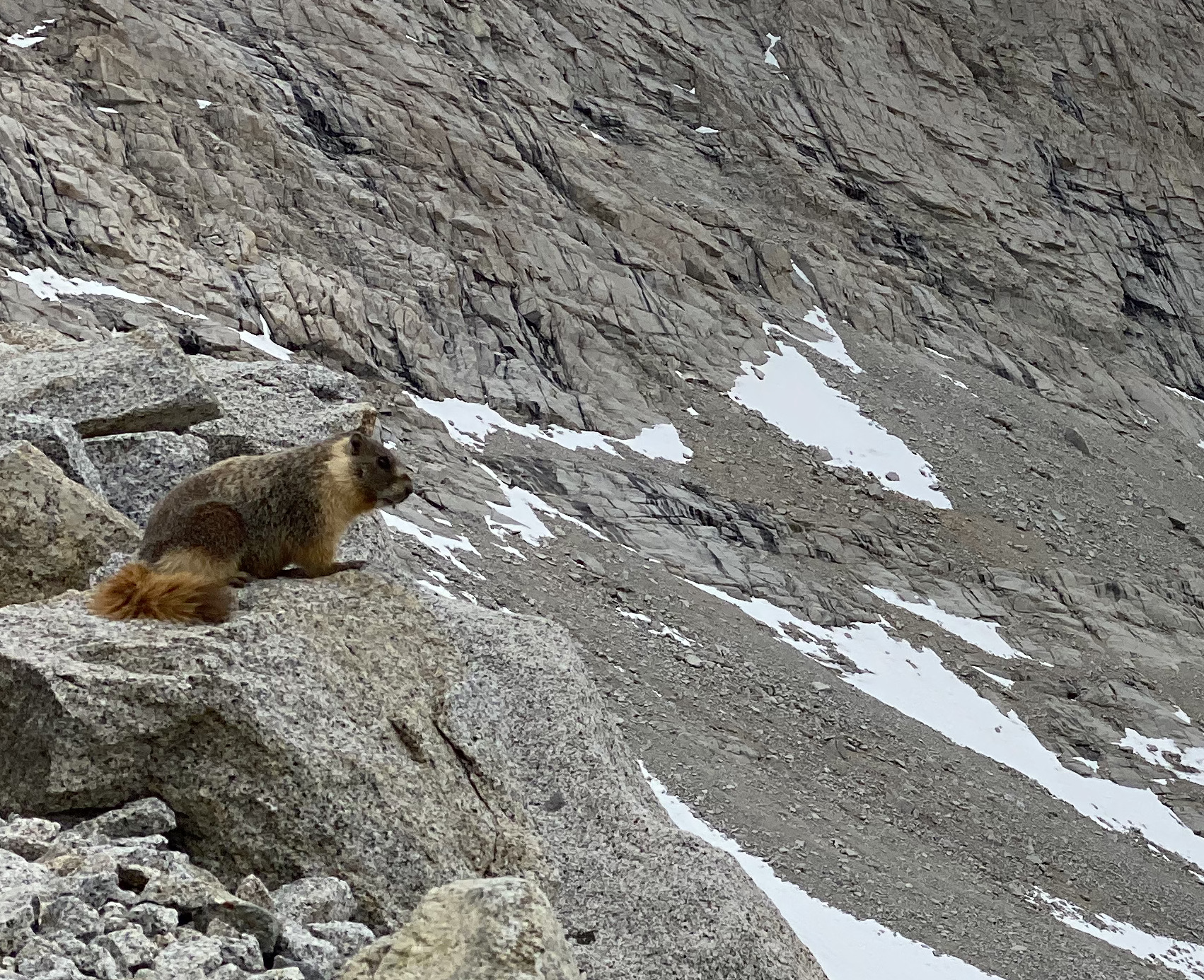
Yellow-bellied Marmot
Of course, we encountered many more critters than just birds – from our first day on the trail, we started to see bushy tails hard at work just off or on the trails. They’re probably busy preparing for mating season – marmots are polygynous with the males attracting several females – and so had a lot to get ready. One surprise was the silent treatment we received from these Marmots – on a previous hike late in the season near Washington’s Goat Rocks (1500 miles in Rib’s future), they would stare us down and emit a high pitch bark to warn their burrow-mates.
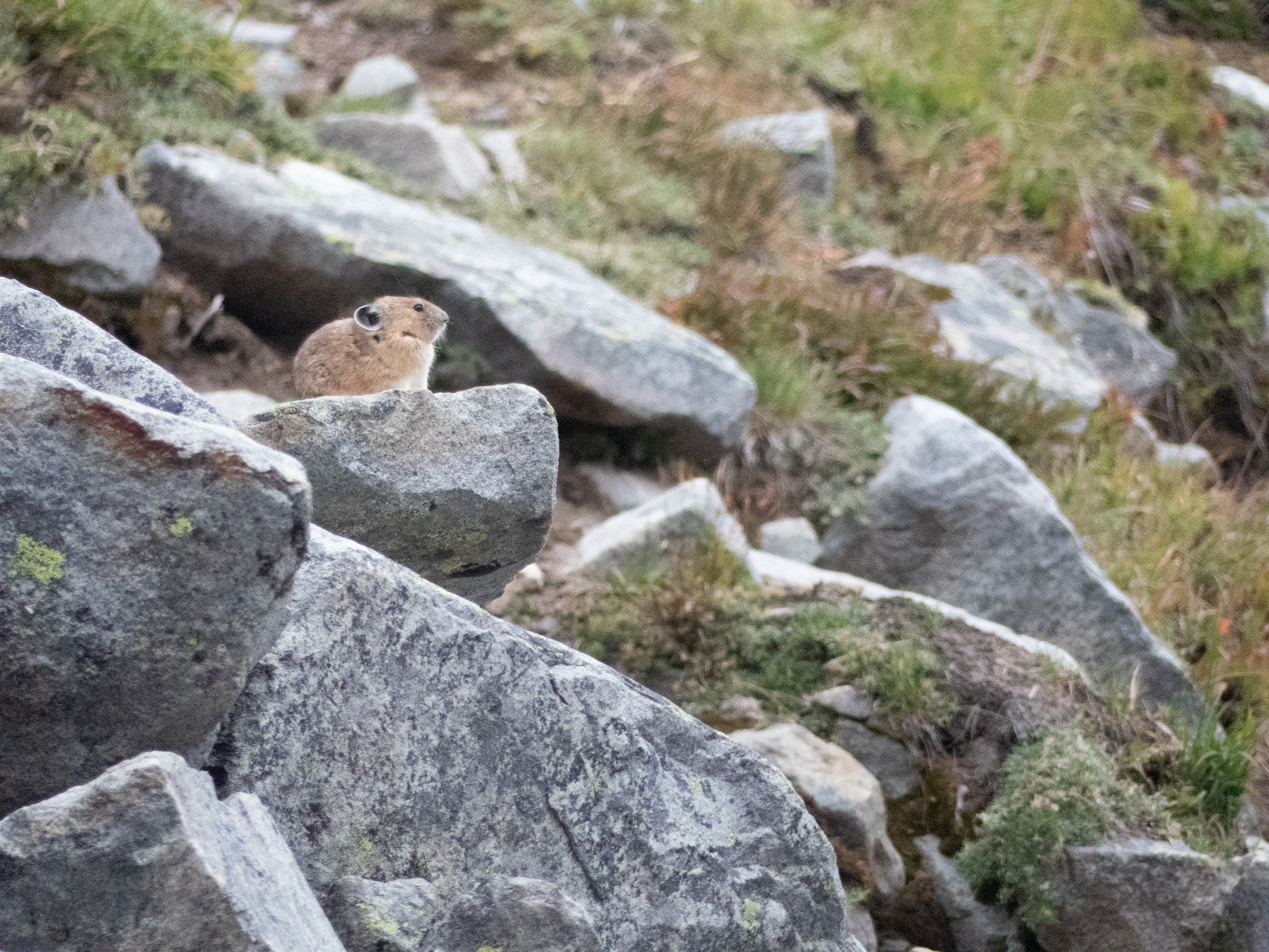
Pika
Speaking of suddenly quiet, we were also surprised by the stony silence we received from Forester Pass’s Pika population. These high-elevation rodents (which we also encountered in the Goat Rocks) are always on the lookout and will squeak to warn the colony when outsiders trespass on the rocky scree where they make their burrows. We only encountered a singular Pika who maybe could tell from our micro-spikes and hurried pace that we wouldn’t be staying long at 13,000 ft as the snow started to fall.
Coyotes

Coyotes were with us for almost our whole journey: from the road up to Kennedy Meadows to our first morning on the trail – their omnipresent prints and scat attests that the Sierra are their mountains. I had been feeling left out after both my parents had spotted their own until I finally bumped into one at Guitar Lake on the way down from Mt Whitney. The large coyote ran along the trail, towards but then away from me, pausing when he was far enough along to give me a once-over before a full-body shake. “Eh, not worth it,” it seemed to taunt with that shake before climbing up the valley towards an easier lunch.
The South Sierra is a landscape of contrast – granite peaks tower over some of the driest and lowest parts of North America. That elevation and rain shadow catches moisture as it moves across the continent, cultivating a lush landscape where life – sequoia, juniper, and mountain meadows – can thrive. And it was a great joy to get to hike through it all and take it in.